If you have a crack (or two) in your foundation, you probably want to know how it got there. I will give you a dozen reasons, and be aware that there are many more options!
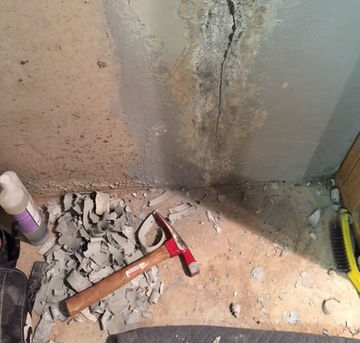
1. Stress. When cement dries it shrinks a bit and pulls together tightly. If it pulls too much, it cracks. These cracks often occur at corners off of windows and beam pockets. These happen on most foundations and are not cause for concern about the safety of your house. You probably want to have them filled however to prevent ground gases, water or bugs from entering your basement.
2. The Mix. When cement is mixed many additives can be used for extra strength, to deal with either hot or cold outside temperatures, or simply because it was specified by the engineer who approved the plans. These mixes can impact drying times and can be affected by outside conditions such as humidity.
3. Humans. Working with cement can cause anxiety. It is very heavy and it is on a timer and will harden whether you are ready for it or not. A team of people with a variety of jobs all have to be perfectly coordinated in order to arrive at the desired outcome. And as we know, if something can go wrong, it will. The truck arrived off schedule, maybe because the person at the plant ran out of raw materials or the driver got stuck in traffic. The site was muddy and the truck couldn’t back all the way to the basement area. The new guy was running his first pour and waited too long between trucks . . .
4. Bad Drainage. When the yard tilts toward the house and wet dirt presses against the foundation for long periods of time, something has to give. When you have matching diagonal cracks on either end of a wall you may want to check what’s going on with the ground outside. Lateral pressure can crack the wall and eventually even push it in or bow it. Relieving the pressure is optimum but sometimes you also have to strengthen and straighten the wall if it gets too bad.
5. Soil. When it rains after a long dry period you get wet dirt. But if that dirt has a high clay content, it also expands and pushes everything near it. When you have a big hole in the ground (e.g., your basement) that is surrounded by clay soil, you get an entire yard pushing in on your foundation. Being aware of the soil types in your area can sometimes help you prepare for and prevent pressure build up.
6. Rust. Metal rebar is put inside concrete walls to add strength. It is ironic then that sometimes that metal is the cause of cracking. If the metal gets wet because it is too close to the surface or micro cracking, it starts to rust and expand. it happens slowly but the power of rust can cause horizontal cracks that can eventually cause serious damage when not treated early.
7. Utility Openings. Ok, the water pipe doesn’t “cause” the crack, but it gives the stressed concrete a head start and an opening. Water can enter through a utility entrance that hasn’t been correctly sealed or it can find the crack that commonly forms off a portion of the penetration. These used to be filled with thin rope and tar or sometimes with hydraulic cement. Injecting an expanding urethane will fill all the gaps and provide a permanent fix.
8. Settling. When the ground under your house moves your foundation can lose some of its support. This could be a tiny pocket that opened right after your house was built due to a small glitch when the ground was being prepared. Or this could be an ongoing problem due to earth being washed out under your footing that needs immediate attention. In either case your footing and foundation are impacted by the ground that surrounds it. Determining if your issue is dormant and non-essential or if your situation requires piering or other measures to stop further damage can be a complex task. It is worth getting up to speed on diagnosis and options if you suspect settling.
9. Hydrostatic Pressure. Groundwater can build up under and around a foundation given the right (or wrong) conditions. This can create enough force to push water through seams and micro fissures to create problems. Often water can be diverted away from a house with gutter extensions, French drains, and catch basins. But when the ground water level rises above your footing, you may also need to create or rehabilitate your perimeter drainage system. A standard system collects water below the top of your footing and pumps it outside where it can drain away from the foundation.
10. Seismic Activity. This could be a local quarry that blasts every day or maybe that 5.2 earthquake from a few years ago. When the ground moves suddenly it has the potential to impact big solid objects like a foundation.
11. Freezing. If you live in the northern half of the country, the ground around your home goes through freeze thaw cycles. In the winter when you get a warm day, the snow melts but then freezes again at night. The problem occurs when that snow-melted water enters small cracks and then freezes and expand when it gets cold again. Rather than causing cracks, this environmental condition can turn your small cracks in to bigger cracks.
12. Creep. This is when the garage slab, driveway, and/or the street combine to treat your foundation with no respect. Locally we are in an area where the soil allows the street to move, which with the right (or wrong) slant can push the driveway against the garage floor, which then pushes laterally against the foundation wall. This is not a stress that foundations are designed to deal with and the the wall gets pushed away. A crack will open up at the outside corner under the garage and several things need to happen in order to repair the foundation. A section needs to be cut out of the driveway to stop it from pressing against the house and the corner of the foundation needs to be reinforced. Sometimes this can be done with carbon fiber strapping.